The Nonlinear World
Second-order effect
In this complex world, there are second-order effects. Many things may "backfire".
Note: "X may backfire" should not be simplified to "X is bad".
In Technology
-
First-order effect: Internet makes knowledge more accessible, making learning easier.
Second-order effect: Misinformation and low-quality contents are also more accessible. Discerning true and useful information is the new problem. Addictive contents are also more accessible, distracting learning.
-
First-order effect: Increasing the sensitivity of alarm improves security because it can catch more anomalies.
Second-order effect: Increasing alarm sensitivity also increases false alarms. Cry wolf syndrome. People are tired of false alarms and care less about alarms.
-
First-order effect: Constraints are bad. It increases cost and reduces possible solutions.
Second-order effect: Constraint can breed creativity. Working in different constraints give different solutions. The variability of solutions can help getting out of local optima.
-
First-order effect: Adding more roads makes traffic faster.
Second-order effect: Braess paradox. Adding more roads can make overall traffic slower.
-
First-order effect: Allowing human to intervene an automation system improves control in emergency.
Second-order effect: When human intervenes some parts of the system, but other parts of the system is still controlled by automation, it creates new failure modes that doesn't exist in pure human control or pure automation.
-
First-oder effect: After an incident, we should find the root cause and focus on fixing the root cause.
Second-order effect: Component substitution fallacy. The reason why other mechanisms doesn't prevent or mitigate the incident is as important as the root cause. Just focusing on the root cause may miss the larger problem.
In Economy
-
First-order effect: The British government in colonial India provided bonus for dead cobra. The bonus could incentivize cobra hunting.
Second-order effect: Perverse incentive. Breeding cobra is easier than hunting wild cobra, so people started breeding it. When the policy is removed, the breeders released their cobra to the wild.
Other examples of perverse incentive:
- The more severe homelessness issue is, the more budget is put into the department for solving homelessness. Then the department has incentive to make the issue worse.
- When repairer's income is tied to repair times, the repairer that only superficially fix and make it break later has higher income.
- When doctor's income is tied to treatment times, the doctor that don't cure fully has higher income.
- Centralized drug procurement selects the bidder with lowest price. This incentivies medicine companies to reduce cost by sacrificing drug quality.
-
First-order effect: Using measured numbers is an objective way of judging performance.
Second-order effect: Goodhart's law. When a measure becomes target, it ceases to be a good measure. Examples:
- When doctors are judged by patient satisfaction survey, doctors tend to do treatments that improve short-term comfort but sacrifice long-term health.
- When KPI punishes based on failure count, then KPI effectively punishes the employee that does more non-trivial work. The more non-trivial things one does, the more mistakes one will make.
- When salesmen are judged by sale amount, salesmen tend to lie to customers and hurt company reputation.
- Training AI model based on user thumbs-up/thumbs-down makes the AI sycophant.
- When promotion is judged by task difficulty, then people do useless hard things instead of important but easy things.
- AB test shows that adding annoying popups and manipulative texts increase conversion rate. However it drives away high-value customers.
- When researchers are judged by paper reference count, there will be researcher groups referencing each other in group.
- ......
-
First-order effect: After the steam engine was improved, it required less coal to do the same work, so the demand of coal would reduce.
Second-order effect: Jevons paradox.The reduced cost of using steam engine greatly increased the usage of steam engine, so the demand of coal greatly increased.
Due to Jevons paradox, increasing efficiency may increase resource waste overall.
Other examples of Jevons paradox:
- Increasing computer hardware performance increases hardware demand.
- Making programming easier increases demand of software development.
- Producticity software redcues working cost but creates more unnecessary work. Convenience of digital document creates more document work. Convenience of digital spreadsheet creates more unnecessary analysis. Convenience of remote meeting creates more unnecessary meetings.
- ......
-
First-order effect: Improving a product can enhance its reputation.
Second-order effect: Improving a product may make it more popular and attract more customers that doesn't fit the product, which may hurt the reputation.
-
First-order effect: Price control reduces price.
Second-order effect: Price control disincentivize production, causing reduced supply, making real price higher. Price control hinders transaction, but people's demand persists, so it leads to black markets, increasing transaction costs.
-
First-order effect: Subsidizing buying house reduces housing cost.
Second-order effect: Housing price increased because of increased purchase power. The surging housing price attracts more real estate investments, driving housing price up even more.
-
First-order effect: Antitrust is detrimental to monopoly companies.
Second-order effect: Antitrust regulations may also increase compliance cost, making competing startups harder to grow, thus benefits monopoly companies. Regulatory capture.
-
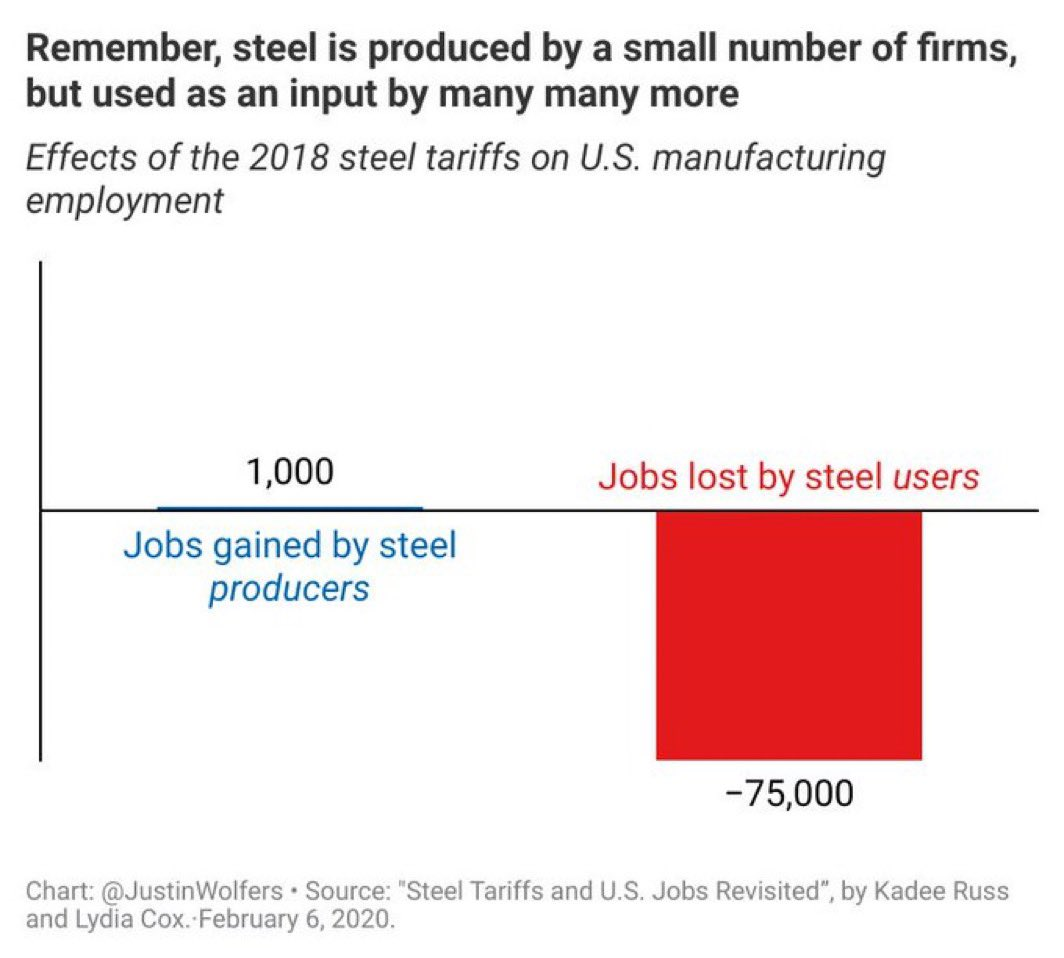
First-order effect: Tariffs protect domestic companies, because it makes foreign competitors' products more expensive.
Second-order effect: Tariff may reduce competition pressure, reducing domestic companies' drive to improve and eventually reducing their competitiveness. Domestic companies may rise price after tariff to increase profit.
Also, the job loss caused by increasing price may be higher than the jobs created by tariff:
-
First-order effect: Advertizements make the product more popular.
Second-order effect: Too much ads may annoy customers1. A bad ad can hurt the brand. The ad that mentions competitor may actually help competitor.
-
First-order effect: Ruthless competition (social Darwinism) will select the best talents.
Second-order effect:
- It may select out the people that are good at competition but bad at cooperating.
- True innovation is risky and takes time. But in high-competition enviornments, temporary failure is fatal. This causes short-termism.
- The previous winners cannot ensure they keep winning, so they tend to find ways to protect them from competition failure, then the selection will become "inaccurate".
- A lot of great talents require more resource investment to show ability, but they may lose the ruthless competition because they initially don't win and can never obtain enough resource. 2
- Talent is high-dimensional. It filters out the talents whose ability is out of testing range. The currently seemingly useless ability may be important in the future.
-
First-order effect: Copyright law protects artists because it makes consumers pay artists.
Second-order effect: The publishers and distribution channels form monopoly naturally. There is no "free market" for artists. Artists have to commission copyright to publishers and distributors. Artists only get a small share of profits, and lose freedom of usage of the artwork.
-
First-order effect: Mineral resources make the country rich.
Second-order effect: Resource curse. Profits in mineral export makes country's currency overvalued. Then importing becomes cheaper than country's own products. so the domestic agriculture and industries cannot develop. Having "easy money" also make people not work hard. When the international mineral price drops, economy collapses.
-
First-order effect: First-mover advantage. The company creating a new product category has advantage. It develops brand recognition and network effect early.
Second-order effect: Second-mover advantage. After the first-mover costly explores different techniques/strategies, the second-mover can directly learn. And the first-mover often cannot correct its mistake due to sunk cost. The second-mover can avoid first-mover's mistakes.
-
First-order effect: When the big companies are in financial hardship, letting them collapse will hurt employment. Subsidizing them keeps employment.
Second-order effect: They become too-big-to-fail. They become inefficient while occupying a lot of resources. They indirectly kill new startups. It reduces overall employment in the long run.
-
First-order effect: Outsourcing reduces labor cost.
Second-order effect: When the actual work is done by only outsourced workers, the formal employees lose control of actual execution detail. The outsourced labors can save cost and cause defects in places that's hard to notice.
The outsourced labors may even gain reverse control of the decision-making because they are the only executors. In the long run, the overall cost is higher because of product defects and higher management cost.
Using AI can also be seen as a kind of outsourcing.
-
First-order effect: To reduce excess inventory, the price should drop to increase sale.
Second-order effect: For things that have investment properties (Veblen good), increasing price could help reducing inventory.
In Finance
-
First-order effect: The release of positive news about a stock causes its price to increase.
Second-order effect: If the market had already anticipated it, and it falls short of high expectations, the price may decline.
-
First-order effect: Price limit up in stock market restricts buying, which helps curb price increase.
Second-order effect: Price limit up avoids market from reaching equilbrium, obsecuring price growing potential, making stock holders reluctant to sell, which may further boost price. Similarily, price limit-down can make potential buyers reluctant to buy, which may boost downward momentum.
-
First-order effect: Restricting foreign exchange helps maintaining foreign currency reserves.
Second-order effect: Restricting foreign exchange makes foreign investors panic, promoting capital outflows through unregulated ways.
-
First-order effect: Quantitive easing reduces financial risk because it increases money supply.
Second-order effect: It inflates asset bubbles and cause more potential risk in the future. It also causes moral hazard and encourages careless risk-takers.
-
First-order effect: Increasing interest rate curbs inflation, because it reduces money supply.
Second-order effect: Many inflations are caused by reduced supply. But interest rate mainly takes effect on demand side. Higher interest rate may cause high-debt companies to collapse, reducing productivity in the short term. Increasing interest rate reduces productivity investment, which can boost inflation.
-
First-order effect: When uncertainty increases, money moves from risky assets (e.g. stock) to gold, because gold is safer.
Second-order effect: When actual large risk occurs, asset prices drop. Leverages face forced liquidation. High-liquidity assets, including gold, are often sold first to get cash to prevent other leverage assets from going zero. This second-order effect is often temporary.
-
First-order effect: If a lot of money is shorting an asset, its price will drop.
Second-order effect: If price grows to a threshold, short positions face forced liquidation, which creates big "buying pressure" and make price grow furthur. It's called short squeeze.
-
First-order effect: Predicting things early helps investments.
Second-order effect: Being too early is not good. The market may take longer time than expected to price in the new status.
-
First-order effect: High-liquidity asset is better than low-liquidity assets.
Second-order effect: Normal people tend to do impulsive trading to high-liquidity assets (e.g. stocks). Impulsive trading often results worse than simply holding. For low-liquidity assets (e.g. real estate) normal people tend to hold.
In Health and Biology
-
First-order effect: Antibiotics cure bacterial infections.
Second-order effect: Antibiotics drive natural selection, leading to the evolution of antibiotic-resistant bacteria, causing harder-to-cure infections.
-
First-order effect: Just eating very few reduces caloric intake, helping weight loss.
Second-order effect: A large calorie deficit may cause higher level of cortiso, inhibiting fat burning, facilitating muscle breakdown, slowing down metabolism, hindering weight loss efforts.
-
First-order effect: Raising children in clean environments make them healthy because they avoid most pathogen.
Second-order effect: Lacking touch with pathogens in young age may cause immune system development issues, then may facilitate autoimmune disease.
-
First-order effect: Advance of medical techonology improves population health and reduce healthcare cost.
Second-order effect:
- Advance of medical techonology increases average age. As age increases, health problems are more likely to appear. The overall healthcare burden increases.
- Some previously fatal disease is now not fatal, but the technology is still not advanced enough to fully cure it. The patient survived but faces low life quality and high healthcare cost.
-
First-order effect: Medication cure diseases.
Second-order effect: There are iatrogenesis, which means the harm caused by medical treatment. Iagrogenesis can be caused my many ways, such as:
- Wrong diagnosis and wrong medication
- Side effect of medication
- Infect at the hospital
- Antibiotics disrupt the gut microbiome, thus interfere with immune system
- Expensive medication costs money
- ...
In Organization
-
First-order effect: Upper management sets very high goals to subordinates. This pushes subordinates to work hard.
Second-order effect: If the management sets high goals but don't have the ability to verify the result, it will be a disaster. Most employees cannot achieve the high goal. The honest employees gets low evaluation and leaves. The employees that fake results get rewarded and stay.
Also, the subordinate can choose to over-execute as a passive-aggressive way to fight back. The subordiante can execute in an extreme way that maximizes the downside of the policy, giving pressure back to higher authority.
-
First-order effect: Having clear team separation in a corporation makes management more efficient.
Second-order effect: When team splits, their goals are less likely to align. It's often that team A depends on team B's results. But team B has its own KPI and that KPI doesn't match team A's need. Team B is not responsible for team A's results. This greatly reduces efficiency.
-
First-order effect: A department having budget surplus shows that the department is over-funded, so reducing its budget saves money for the organization.
Second-order effect: Saving money is effectively punished by reducing budget. After learning this, the department will do excessive spending to avoid any surplus that causes budget reduction. This greately increases money waste in the organization.
-
First-order effect: Promoting employees that did great job incentivizes employee. It makes the company more efficient.
Second-order effect: Peter principle. The promoted employee is not necessarily good in new job because the work changes. But the employee performing bad in raised position is rarely demoted. So "being good at work" is unstable state, but "being bad at work" is stable state. Eventually it likely reaches stable state: most employees do the work they are bad at.
-
First-order effect: A well-estabilished confidentality system helps keeping internal secrets.
Second-order effect: In bureaucratic organizations, responsibility evasion is common. Not approving document access bears fewer responsibility. Then the ones actually needing information may cannot access. See also Institutional memory and reverse smuggling.
-
First-order effect: Solving problems make problem fewer.
Second-order effect: When solving problem, the first thing is to reveal problems. However revealing problem will make things look worse temporarily. And people tend to associate problem with who reveals the problem.
-
First-order effect: A politician should reward their loyal supporters.
Second-order effect: The loyal supporters are loyal, so increasing or decreasing rewarding to them doesn't change their stance. On contrary, rewarding swing voters has larger utility for the politician. So the politician may reward the swing voters in expense of loyal supporters. This is unsistainable in the long run, but effective in the short run.
The minority swing voters may have big impact on policies.
-
First-order effect: Widsom of the crowd. The more people discussing the decision, the better decision-making will be.
Second-order effect: Most decisions are tradeoffs that cannot please everyone. The more people discussing, the more likely the decision gets pushback, then the decision cannot be made. Also, the more people involved, the more likely the secret gets leaked. Most important decisions are made in small private meetings.
-
First-order effect: The more penality enforced to subordinate when an incident comes, the less likely incident happens.
Second-order effect:
- There is information gap between subordinate and upper authority. The fear of punishment may cause subordinates to focus on hiding the "bad news", instead of solving problems.
- The subordinate may waste too much resources to reduce incident to the extreme, when it's no longer economical.
- The subordinate may "extend the mistake" and make it "too big to fail" to gain leverage in bargaining with upper authority.
In Psychology
-
First-order effect: Suppressing own emotion helps overcoming that emotion.
Second-order effect: This may make the emotion stronger and may unleash one day.
-
First-order effect: Praisng a product improve people's impression of a product.
Second-order effect: Praisng a product raises people's expectation, which may lead to disappointment if the actual usage experience doesn't meet the high expectation.
-
First-order effect: Having eagerness helps achieve the goal.
Second-order effect:
- Being too eager may deplete patience when faced with failures. Yerkes-Dodson law.
- Desperate eagerness is a sign of low confidence. In dating, sales and interviewing, signs of low confidence reduce chance of success.
-
First-order effect: Suppressing the publication of some information stops its spread.
Second-order effect: Trying to suppressing information may make people gain more interest in that information. Streisand effect.
On the contrary, when information is not being suppressed, people tend to stay inside the information coccon that they are comfortable with.
-
First-order effect: Disallowing kid to play videogames makes kid not play videogames.
Second-order effect: Reverse psychology. The kid being not allowed to play videogames may become more eager to play them.
-
First-order effect: Providing money reward incentivizes people.
Second-order effect: Overjustification effect. Providing external reward can reduce internal motivation.
On contrary, not providing money reward can filter out the money-seekers and attract the people having internal motivation and taking pride in the work, see also.
-
First-order effect: Having choices is good as there is more freedom.
Second-order effect: May waste more time considering which choice is better.
Divination has real utility: it makes one quickly make decision, stopping wasting time considering which is better.
In bargaining, the party that has no choice but fight has advantage over the party that has fallback choice.
-
First-order effect: Smart people's beliefs are more correct because they are smart.
Second-order effect: Smart people are also more smart in making up reasons to justify their own belief (motivated reasoning and confirmation bias).
-
First-order effect: Giving away free things can generate goodwill and appreciation.
Second-order effect: Some recipients may take free things for granted, complain about not receiving more, or criticize the quality. The recipient also may feel having lower social status and may develop hatred.
-
First-order effect: Giving clear unambiguous feedback helps learning.
Second-order effect: It makes student overly rely on external feedback. Then the student can hardly develop internal judgement, thus perform worse in real-world tasks that don't have clear feedback. See also
-
First-order effect: Knowledge helps decision-making.
Second-order effect:
- Partial understanding gives fake confidence (Dunning-Kruger effect).
- Knowing more about possible risks make one hesitate in making decisions, reducing agency. Often the innovation can only be done by the people not knowing the risks.
Deep understanding is often not required for real-world success (green lumber fallacy3). The idiom "knowledge is power" is not always true. The true knowledge includes when to not use knowledge.
There are many cases where the problem is solved (or alleviated) by just trial-and-error, without understanding the problem.
-
First-order effect: Punishing mistakes will force people to make fewer mistakes.
Second-order effect: It cause one to be scared of practicing, thus gain less experience. Lacking of experience makes one more likely to make mistakes.
-
First-order effect: Making software react faster improves user experience.
Second-order effect: If it's an AI application, the user tend to think fast AI is dumber than slow AI.
-
First-order effect: Rationality allows making optimal decision, gaining advantage.
Second-order effect: Rational decision-making also means that opponent can often accurately predict the behavior, which causes disadvantage.
-
First-order effect: A centralized organization/movement can be defeated.
Second-order effect: After breaking the organization, if the idea behind it is still popular, then it becomes decentralized and more resilient. Its activities become more sparse so it's harder to defense. And there will be no one to negotiate with.
-
First-order effect: Trying to achieve perfection will make one do better.
Second-order effect: Perfection can be the enemy of good. (e.g. trying to buy at the lowest point makes one not buy in the bottom range)
-
First-order effect: When waiting on one thing to finish, switch to do another work can improve efficiency.
Second-order effect: Frequent switchings cause distraction, which may cause one to forget the context, or make more mistakes (brain is not computer). Focusing on one task and patiently waiting can be more efficient overall.
In Cybersecurity
-
First-order effect: Forcing the user to login again after inactive for 2 minutes can improve security.
Second-order effect: Users are frustrated by frequent logins and may try to make login as easy as possible, like using simple passwords or keeping passwords in clipboard. Also auto log-out may happen during critical work.
-
First-order effect: Complex password requirement can improve security.
Second-order effect: The user may forget the complex password, so the user may write down the password somewhere to avoid the trouble of reseting password every time.
-
First-order effect: Enforcing password rolling can improve security.
Second-order effect: The user may reduce the memory pressure by using regular passwords (like AAABBB111, CCCDDD222), to avoid the trouble of reseting password every time.
-
First-order effect: Security guardrails of AI model makes it more secure.
Second-order effect: The security guardrails being too sensitive makes model unable to help with user's security problem.
When we started the log analysis, we first used frontier models behind commercial APIs. This did not work: the analysis requires submitting large volumes of real attack commands, exploit payloads, and C2 artifacts, and these requests were blocked by the providers' safety guardrails, which cannot distinguish an incident responder from an attacker. We ran the forensic analysis instead on GLM 5.2, an open-weight model, on our own infrastructure. This had a second benefit: no attacker data, and none of the credentials it referenced, left our environment.
-
First-order effect: If some operation is dangerous, requiring human approve can improve safety.
Second-order effect: Approval fatigue. It's common that most requests are benign. But some very rare requests are very dangerous (danger distribution is fail-tailed). The approver is tired of approving the most benign requests and loses patience. Then approver tend to quickly approve without careful checking.
Also, if the approver is in another department that's responsible for safety but not responsible for your results, then the approver tend to not approve to reduce responsibility. Thus the work tend to be blocked.
In Software
-
First-order effect: Better hardware makes software run faster.
Second-order effect: Better hardware performance make software developers focus less on optimization, resulting in slow software.
-
First-order effect: Adding developers to a software project can accelerate it.
Second-order effect: It may increase communication cost and cause more chaos. Man-month myth.
-
First-order effect: Adding more features make the software more useful.
Second-order effect: Adding features also may cause regression bugs. The new features can slow down the software even when the user doesn't use it. The new feature increases long-term maintenance cost. The new feature's interactions with old features may also cause confusion to the user.
-
First-order effect: Abstraction helps understanding and maintaining code.
Second-order effect: Abstraction also comes with constraints. If the new requirement doesn't follow the constraint of the abstraction, then the developer need to either add exception case handling throughout the abstraction, making code hard-to-maintain, or refactor the abstraction.
-
First-order effect: Observability and telemetry systems help the reliability of the service.
Second-order effect: When the system becomes stable enough, observability and telemetry may accidentally break the system.
In short, the root cause was a new telemetry service configuration that unexpectedly generated massive Kubernetes API load across large clusters, overwhelming the control plane and breaking DNS-based service discovery.
Once a system reaches a certain level of reliability, most major incidents will involve:
- A manual intervention that was intended to mitigate a minor incident, or
- Unexpected behavior of a subsystem whose primary purpose was to improve reliability
-
First-order effect: Enforcing high unit test coverage could improve software quality.
Second-order effect: Developers tend to write low-quality test to increase test coverage (Goodhart's law). The low-quality tests are worse than useless because their failures are likely false-positive.
Feedback loops
Self-reinforcing feedback loops
Examples:
- Matthew effect. Having money helps earning money and vice versa.
- Network effect. The more people using a platform (like X(Twitter), Facebook, Uber) the more usable platform is, so more people use it.
- Flywheel effect. Some operations are initially costly and inefficient. But keep doing it makes it easier and easier.
- Economies of scale. Increase production can amortize research costs, marketing costs and other fixed costs. Financing is also easier on larger scale.
- Virus spread. The more it infects, the more sperading sources.
- Self-fulfilling prophecy. Some examples:
- When people believe in a plan, people collaborate more and invest more, then it's more likely to succeed.
- Bank run. Some people not trusting bank make bank's financial status worse and less trustworthy.
- Teacher dislikes a student and give bad feedback, then student have less motivation to learn thus perform worse.
- A commodity originally has supply-demand balance. When someone buys a lot of it, price increases, people think it has a shortage then buy more eagerly, then shortage becomes true and price furthur increases.
- Bad emotion causes one to ruminate, then cannot pay attention to current task, then makes mistake, then emotion becomes worse.
- ...
- Attitude can shape behavior. Behavior can shape attitude. Persuade self to justify decisions.
- Social interaction. One being angry to another may make two both more angry. Also applys to friendliness and trust/distrust.
- Herd mentality. Some people do something, more people follow.
- Financial market momentum.
- Financial system often "give umbrella on sunny day, take back on rainy day".
- Debt can both accelerate growth and accelerate bankruptcy. Banks only loan to companies with good financial status.
- The worse health condition is, the more expensive health insurance is (in America), the less likely one affords treatment.
- Spread of information and idea. The more popular a piece of information is, the more chance it spreads.
- Sunk cost. The more resources put in, the higher sunk cost is, the harder to stop loss.
- This also applies to war. When both sides costed a lot in war, the war is hard to stop.
- Ponzi scheme. When one falls into a Ponzi scheme, one tend to spread the scheme to reduce own loss.
- Recognition of power. When one uses power and succeeded, the observers confirm the power. When a rule is broken once and there is no consequence, then more and more people will break the rule.
- Avalanche.
- Cascade failure.
- When using AI output to train AI model, a feature could reinforce itself, see also.
- ...
Concentration
Self-reinforcing feedback loops cause concentration and winner-take-all effect.
Examples of concentration and 80/20 rule (Pareto principle):
- For business:
- Most profit often come from very few products.
- For to-business products, most profit often come from few enterprise customers.
- Most complains often come from very few users.
- Most meaningful knowledge work is done by few employees. (On the contrary, the contribution of physical work is more even.)
- On internet:
- The most engagement come from very few posts.
- The most voice on internet comes from a minority of users. The dominant narrative on internet may not represent most people's views.
- In software:
- Most users use few common features.
- Most issues that user see are caused by few common bugs.
- Most complexity (and bugs) come from very few features and requirements.
- Most development efforts are for fixing edge cases. Few development efforts are spent on main case handling.
- One bug applies to all instances of the software version.
- The most social connections are related to few core people.
- The most decisions are made based on few important information.
- In financial market:
- The most volatility concentrates on small time intervals.
- The most profit and loss come from few important investments.
- The most market value and trading volume concentrates on few assets.
- About risk:
- Most car crashes are caused by few drivers.
- The most negative impact come from very few severe incidents.
They have fat-tailed distributions instead of normal distributions.
For them, the mean and variance may be misleading. Median is more representative than mean. The sample variance is likely very underestimated.
If some work seems huge, if it follows 80/20, doing just 20% of it can get 80% of effects. However note that not all work can be 80-20-ed.
Also, most jobs are concentrated in time. One example is infrastructure building. Infrastructure building are often concentrated in time (due to e.g. economic cycle, policies, interest rates). After the wave ends, most infrastructure-related jobs vanish. Another example is that when war ends, war industry manufactoring demand plummets. The "temporary jobs" can keep being ample for many years. This can confuse people into beliving that these jobs are permanent. Most jobs are inherently temporary.
"Circular proof"
In math, circular proof is wrong. You cannot prove by "if A then B. if B then A. So A and B are true". However, the self-reinforcing feedback loop can crate "circular proof". It's common in finance: one asset's price is growing, so people invest in it, so asset price grows. But these kind of "circular proof" are not permanent. 4
Self-balancing feedback loops and cycles
Examples:
- In nature: predator-prey relation, climate systems.
- In human body: temperature adjustment, blood glucose adjustment, etc.
- In machines: thermostat, etc.
- Planet movements: day-night alternation, seasons, the Milankovitch cycle.
- Demand-supply relation: high demand increase price. High price facilitates investments in supply (this can take time) and reduces demand (people search for alternatives), thus causing price drop.
- In financial market:
- Price grow create potential for selling and vice versa. Market momentum cannot continue forever (although it may be much longer than expected).
- Profit reduces as trading size grows when it drains up liquidity.
- If one financial trading strategy is effective and many people use it, then that strategy will cease to be effective. If everyone believe that one strategy is ineffective, then it may be actually effective. Market is anti-inductive.
- Low volatility induce higher leverage that potentially increases volatility. High volatility provide potential profit for hedging that may lead to reduced volatility.
- Two uncorrelated assets may be commonly diversified together that may potentially increase their correlation.
- The debt cycle. Economy growth parallels debt growth. Higher debt impose higher risk and more interest cost. Then debt collapses and inefficient companies bankrupt. The economy becomes more frugal and more efficient. The debt level becomes low again.
- The Kondratiev cycle. New technology drives growth and investments. The application of new teconology matures and growth plateaus, creating excess investment, excess debts and inflation. Then recession comes. A new radical innovation drives a new cycle.
- The demographic cycle. Ancient China suffers from Malthusian trap: Population grows, farmland per capita reduces, food supply cannot catch up population. When it's close to threshold, a natural disaster can cause famine (and war), reducing population.
- Economies of scale eventually faces diminishing marginal return. And larger scale makes management harder.
- Over-concentration of wealth and power reduces efficiency and stability of society.
- Large companies are likely to be inefficient due to bureaucracy.
- The innovator's dillema. Large companies are bad at innovation.
- "Hard times create strong men. Strong men create good times. Good times create weak men. Weak men create hard times." ― G. Michael Hopf
- Boredom with memes. Attention span on internet is short. No meme can keep dominating.
- Elo-score-based matching in PvP games. If you lose, you will match with lower-skilled players and be more likely to win, and vice versa.
- Cry wolf syndrome. False warning make people less sensitive.
- Cooperating and cheating. When no one cooperates, the group that cooperates gain advantage. But when everyone cooperates, the ones cheating gain advantage.
Note that "negative feedback loop" means self-balancing feedback loop, but sometimes it is also (mis)used to describe "self-reinforcing feedback loop with negative effect" like financial crisis.
The force behind a self-balancing feedback loop may drive self-reinforcing feedback loop in the next stage of cycle.
The "competition" between self-reinforcing feedback loops and self-balancing feedback loops:
| Self-reinforcing | Self-balancing | |
|---|---|---|
| Population growth | Exponential growth | Limited food supply, living resources and jobs; Higher competition |
| Asset price grow | Trend following investments; Fear of missing out; Overconfidence; Leverage | Long force depletes; Short potential accumulates |
| Asset price drop | Panic; Margin call | Short force depletes; Long potential accumulates |
| Debt growth and inflation | Economy growth; Higher confidence | Cost of excess invstment and debt; Monetary tightening for keeping currency credit |
| Monopoly | Matthew effect; Economies of scale; Brand recognition | Antitrust; Safety concerns; Innovator's dillema; Bureaucracy within large company |
| Scaling of production | Amortize cost | Harder to manage; Diminishing marginal return; Higher risk |
| Virus spread | The more it infects, the quicker it spreads | Immunity; Societal countermeasures; Medication; Natural selection |
Note that nonlinear systems are complex. They are more than just two kinds of feedback loops.
More is different
Sometimes, when one thing reaches a threshold, things become very different. Sometimes it accumulates potential and suddenly release the potential one day.
- A technology used to be bad but keeps improving. Once it improves above a threshold, it suddenly becomes economically valuable and get deployed widely.
- An undervalued asset's fundamental keeps improving. Once there is some public event showing it, its price may suddenly grow a lot. Vice versa for bubble assets.
- A system cuts cost by reducing safety investments. The existing safety investments gradually decay. When it decays to a point, a random event can trigger a large incident.
- ...
There are emergent properties that only emerge if scale becomes big enough:
- The market price comes from the decisions of many individuals (and quantitive trading programs).
- Scaling up (model size, data, etc.) in deep learning lead to new behavior (e.g. in-context learning, pass Turing test).
- Ant colony, bird flock behavior, etc.
- ...
Composition fallacy: composing things together may give surprising results. Two good things composed may be bad, and two bad things composed may be good.
The law of large number only works if the samples are independent.
Fractal properties
The relation between cycle and trends is similar to fractal. There are small trends in cycles. There are also small cycles in trends. There are small cycles in cycles.
Investing in index is long-term trend following, as the index selects the winning stocks. If the index has position limitation for each individual stock, then it also incorporates contrarian investment. (Note that market is anti-inductive. The more money investing in index, the more index front-running is profitable.)
Heinrich's law: for every accident that causes a major injury, there are 29 accidents that cause minor injuries and 300 accidents that cause no injuries.
Cannot predict accurately
Nonlinear systems are chaotic. Predicting them accurately is practically impossible.
There are many conflicting factors. For example, if inflation increases, first-order effect tells gold price will grow, and second-order effects tells that increased inflation cause Fed to tighten money so gold price will drop. Due to hindsight bias it's always easy to explain history. If gold price grows, explain that first-order effect is stronger. If gold price drops, explain that second-order effect is stronger. But being able to explain history doesn't mean being able to predict future.
Pursue simpler predictions instead of fragile complex specific predictions. Many tightly-dependent predictions tend to fail together.
Sometimes, just being less wrong than others can gain advantage.
If something appears irrational but existed for a long time, it's likely that you don't understand it.
What everyone believes may one day turn out to be false.
There are great ideas that are hard to discover, but once discovered, become very obvious and very natural (hindsight bias).
Paradigm shifts
Paradigm shift could be caused by radical technological innovations (e.g. invention of Internet), natural disasters (e.g. Covid-19), or a release of accumulated potential.
For a long cycle that spans decades (e.g. macro debt cycle), entering the next stage of cycle is a paradigm shift.
History and societies do not crawl. They make jumps.
- The Black Swan
There are decades where nothing happens; and there are weeks where decades happen.
- Vladimir Ilyich Lenin
Experiences may be obsolete or even harmful after a paradigm shift. Ideas, methods, cultures and systems may only work in specific paradigms.
Unity of opposites
- Abundance could lead to waste. Scarcity could lead to efficiency.
- Laziness could lead to innovation. Diligence faces diminishing marginal return and involution. When the direction is wrong, dilligence compounds error.
- Danger could lead to deterrence and unity. Safety could lead to ignorance and fragility.
- Being advanced could lead to path dependence. Monopoly make competitors search for alternatives that may lead to disruptive innovation.
- The most severe risk could come from the thing you trust the most.
- Freedom can lead to imitation. Constraint can lead to innovation.
- The fundamental is the simplest (大道至简). The profound intelligence appears foolish (大智若愚). The rise of worse is better.
About optimizations
-
Almost all optimizations are tradeoffs. Some tradeoffs are hidden.
-
Optimization may backfire (the previously mentioned second-order effects). Sometimes not optimizing is better.
- Sometimes winning just requires doing nothing special and let opponent make mistakes.
- The "good people" with "good intention" can cause more damage than "bad guys", because optimization backfires.
-
The more important things (e.g. internal quality) are often hard to measure. Optimizing on easy-to-measure thing ultimately backfires.
-
80/20 rule. Sometimes optimizing just one important part can have big impacts. Note that this doesn't apply to everything.
-
Diminishing marginal return. Overly optimize one aspect is usually a bad tradeoff. Pursuing perfection is often unrealistic.
-
"Everything in moderation, including moderation". Keeping things in the middle is often fine.
- Related: Yerkes-Dodson law: Medium motivation or stress works the best. Too much or too few motivation or stress don't work well.
-
It's often that long-term benefit requires short-term cost. Getting out of a local minima often requires temporarily increasing loss.
-
Optimize for the root goal instead of sub-goals. A sub-goal may originally serve for the root goal but now conflict with the root goal. Be ware of means-end inversion (goal displacement).
Question the constraints of the optimization. Some constraints are caused by historical reasons and is unnecessary now. There are also cases where a constraint leads to innovation.
-
Right decision can fail and bad decision can succeed due to randomness. Results may be misleading.
-
Theory of the second best. If something is imperfect, adding more imperfection may be better overall.
High-dimensionality
About health: Some people treat health as a score. After eating unhealthy food or staying up late, the score decreases. And the score can be earned back by taking supplements and exercising. This view is wrong. It simplifies high-dimensional health status into a one-dimensional score.
About AI: Current AI can solve PhD-level exam problems that 99.999% people cannot solve. But AI doesn't actually achieve PhD-level intelligence. Intelligence is high-dimensional. Solving exam problems is just one dimension.
Simplifying a high-dimensionality reality into a one-dimension number is often wrong.
About risk
3 kinds of risks
- The risk we know and prepared for.
- The unknown unknown (Black Swan).
- The risk that we know but don't want to accept and act on (Grey Rhino, ostrich effect, elephant in the room).
Redundancy
Redundancy tackles risk. Two kinds of redundancy:
- Resource redundancy. Example: save more cash; hoard emergency food.
- Functional redundancy. Example: be more versatile and can change profession; have a plan B when plan A fails.
Diversification is also a way to handle risks. Note that diversification only works when correlation is low. Many assets seems low-correlation but has high correlation under Black Swan event. When two low-correlation assets are commonly diversified together, their correlation potentially increases.
Good sides of incident
- It reveals problems and gives pressure to improve.
- It makes people appreciate the good instead of taking things for granted.
- It justifies the cost of security investments. Without incident happening, most people don't see the value of security investments.
- In many cases, you cannot correct a system's mistake in normal ways, because the system is trapped in a local optimum. Trying to correct mistake in normal state only makes it worse. But when an incident comes, it gives enough pressure to move it out of local optimum and then have chance of improvement.
- ...
Diversity and "blind sopts"
Everyone has some "blind sopts" in thinking. It may be path dependence: Someone tried X, succeeded, then think X is the final answer; tried Y, failed, then think Y will never work. Sometimes an idea requires doing a specific thing to inspire.
Fixation: sometimes one person overly focus on one aspect of problem or one possible hypothesis, then "fall in love with the idea" and reject other ideas. Both human and AI can suffer from fixation.
When there is diversity, different people can communicate different ideas and try different ideas. This increases of the overall "search space" and improve chance of overall success.
Efficiency often requires centralization
Bitcoin can only process 3 to 7 on-chain transactions per second, and it takes about 5 minutes to get first confirmation for each transaction. But a centralized Bitcoin exchange center can process transactions much quicker.
There are faster decentralized cryptocurrency protocol designs. But doing big upgrade to Bitcoin protocol is nearly impossible because it requires consensus of major players (block size war), and there are interest conflicts. But banks and exchange centers can upgrade its software without most customer's aggrement.
It's a common belief that planned economy is inefficient. But within each cooperation, the resources are often allocated by top-down planning, which is "planned economy". It depends on the scale. Centralization is still the most efficient in the small scale, but not in the large scale. The larger the scale is, the harder it is to understand and control the system, and the more costly a wrong decision is.
Contrarian strategy
- The seemingly good opportunities are often highly-competitive and not worth joining. Being the upstream or downstream of a highly-competitive field could be better ("Picks and Shovels" strategy).
- The seemingly bad opportunities are worth considering. These are not competitive.
Many good ideas initially look bad:
By 2005 or so, it will become clear that the Internet's impact on the economy has been no greater than the fax machine's.
- Nobel Prize-winning economist, Paul Krugman, in 1998
Note that competitiveness is relative to the market size. A quickly-growing market is not competitive even if it seems so.
On planning
In many cases, the real-world feedback invalidates assumptions in the plan. Then it's important to correct the plan. Beware of sunk cost fallacy.
Success usually requires a lot of trial and error. Be more forgiving to the many failures in the process of trial and error. (It's also hard to do.)
Innovation cannot be planned. Having diversity of ideas and constraints could help innovation.
A complex system that works is invariably found to have evolved from a simple system that worked. A complex system designed from scratch never works and cannot be patched up to make it work. You have to start over with a working simple system.
- Systemantics: How Systems Work and Especially How They Fail
Real development often works incrementally. Without the foundtion, a too advanced "grand plan" fails.
Top-down control doesn't work well
Law of requisite variety tells that the controller must be more "flexible" and "versatile" than the target being controlled, otherwise controlling fails.
The book Seeing like a state describes that governments want to make things legible to manage, thus reducing complex reality to numbers and symbols. However, the illegible things (cannot be simply tracked by numbers) are also important. Goodhart law is caused by the legible number being different to the actual objective.
However, governments (and large coorporations) still highly focus on legible information because they also want to maintain authority and want to control things. The illegible things are percepted and controlled by actual executors that the upper authority doesn't fully trust. And the simplified numbers are simple so it makes management "scalable".
The rule and the execution
It commonly seen that rules control execution. But in reality it's often that the actual execution defines the real rule. The rigid rule defined by authority cannot adapt to complex and variable reality that executor faces. So enforcing the explicit rigid rule is often actually "bad" for both authority and executor.
Allowing tacit rule both helps executor to get more freedom to do actual work. For authority, there is optionality: if result is good, it's tacitly allowed because it benefits both. If result is bad, the responsibility is in executor not authority, because executor is the one violating the rule.
As previously mentioned, the real rule has self-reinforcing feedback loop.
- If one rule is broken but not being punished, when people observe this, more people will break the rule. The rule de-facto breks.
- If one does something outside of rule but gets good result, and the management tacitly allows, then the rule de-facto forms.
(Similar principle also applies in software: Hyrum's law.)
The flip side of advanced technologies
Technology advancement usually involves scaling: scaling size, scaling energy, scaling velocity, scaling precision, scaling density, scaling connection, scaling computation, ...
Scaling often involves higher fragility and higher cost (e.g. advanced chip manufacturing), and eventually facing diminishing marginal return. Scaling of connection also boost concentration and Matthew effect.
Advanced technology is often more fragile or has unobvious downsides. It often requires a balance between convenience of advanced technology, and reliability of primitive methods.
Advanced but expensive technology may defeat due to financial sustainability.
In capitalism, technologies are usually developed for profit, not for human well-being (e.g. processed food, algorithmic recommendation, AI training data collection).
If a piece of software has a bug, then every copy of the same version of software has the same bug. This is a source of fragility. For example, if a self-driving program has a bug, then all self-driving cars that deploy such program has the same bug. On the contrary, it's unlikely that all drivers in world has the same hidden blind spot.
Modern advanced manufactoring is often very capital-intensive and fragile. It can be overcomed by counter-cyclical subsidy, but the subsidy can easily fall into sunk-cost trap and crate "zombie" enterprises. Unfortunately, the more advanced manufactoring is more capital-intensive and more fragile.
Fragility of automation
When automation works, it's good. But automation may break. When it breaks, no one is familiar to it or has experience to fix it. The automation may be set up years ago and the person familiar with it may have left.
it was an auto-renewal being bricked due to some new subdomain additions, and the renewal failures didn't send notifications for whatever reason. And then it took some Bazel team members who were very unfamiliar with this whole area to scramble to read documentation and secure permissions... and the SSL certs taking ages to propagate as usual.
- Link
Principal-agent problem
Principal-agent problem is one of the core problems in human society. It's very hard to align the interest of the agent with interest of you. Many second-order effects mentioned previously is one aspect of the problem.
And AI is also a kind of agent. The principal-agent problem still exists even with AI, but the exact shape of problem is different. One aspect is reward hacking.
AI reward hacking
Reinforcement learning requires a mechanism to tell which behavior/result is good and which behavior/result is bad. Then there is the reward function. Sometimes reward is specified by human manually, sometimes reward is computed by a program, sometimes reward value also comes from AI. The reinforcement learning makes AI do things that get high rewards.
However, the reward value is a proxy to the actual objective that human wants AI to do. Just like Goodhart's law, the measured number is a proxy of actual objective. AI can use the easiest way to achieve high reward, without doing what human actually want AI to do. This is reward hacking.
It's fundamental that it can only be alleviated but cannot be fully prevented. Also, scaling may make the problem worse (smarter AI is more smart in reward hacking). Reward hacking may be a core reason that AI cannot replace some human jobs.
Short-termism and long-termism
Long-termism can usually gain advantage. However long-termism is often fragile because it involves more investments. The fruits of investments may be taken by others. An unknown incident may break the investment. Long-termism only works in safe and stable environments.
Sometimes the distinction between sunk-cost fallacy and long-termism is blurry.
It's often that the process of doing improvement has risks. But the improvement can avoid bigger risk in the future. Under short-termism, it can only stuck in local minimum, avoiding risky improvement.
Stock market pricing is often short-termism, which often cause company decision-making to also become short-termism:
- Sometimes the investors care too much about short-term shareholder return and don't understand value of long-term investment (e.g. product quality, company reputation, research).
- Sometimes the investors care too much about short-term price trend. When there is a bubble, company tend to do irrational investment to prop the bubble. The story behind bubble only pays off after long time, but it's not rational long-termism.
Most essential work is not "core"
- In the chip, the transistors that actually do compute (addition, multiplication, etc.) only consume a tiny portion of power. Most power is used for storing data, moving data and controlling what to compute.
- In workplace, the efforts spending in actual work is small. Most efforts are in communication and debating of what to work on.
- In AI / data science work, cleaning data often has more impact to results than designing a new fancy algorithm. No matter how advanced algorithm is, garbage-in-garbage-out applies.
- For many kinds of commodity, the main cost comes from shipping and warehousing in the whole supply chain, not the production itself.
Related
Many ideas in this article are learnt from N. N. Taleb's books: The Black Swan, Antifragile.
See also: How Complex Systems Fail
Footnotes
-
There is a third-order effect. If consumer hates the ad, seeing more ads hate more, but the ads still leave "footprint" in memory. Due to sleeper effect the customer may start liking the product after some time. ↩
-
Related: Qianlima (千里马). The high-capacity horse require more food to show its capacity. But without showing its capacity it can never get enough food supply. ↩
-
Green lumber fallacy: one trader mistakenly thought "green lumber" means wood in green color, but green lumber actually means freshly-cut wood. But the trader still succeeded in trading green lumber. The market is highly random and anti-inductive. It's often that luck overrides understanding. ↩
-
There is a "circular proof" in physics, called Participatory Anthropic Principle: the universe crates observer, and observer makes universe exist. ↩